 our story
Biodiversity and food hang by a thread—and that thread runs through our plates.
A piece of fruit, a square of chocolate: behind each one lies living soil and a whole community of species supporting one another so that the harvest can reach us.
Imagine nature as an immense web. Each knot is a species, and each thread is a relationship connecting it to others. Pull on just one knot, and the entire web moves.
When one species becomes extinct, it rarely takes only its own thread with it. It causes others to break too, often silently. Scientists have a word for this phenomenon: co-extinction.
Understanding this mechanism changes the way we look at nature and the real impact of our food choices.
Because while our actions can unravel these connections, they can also protect them—from salmon all the way to cocoa.
It all starts with the documentary Coextinction
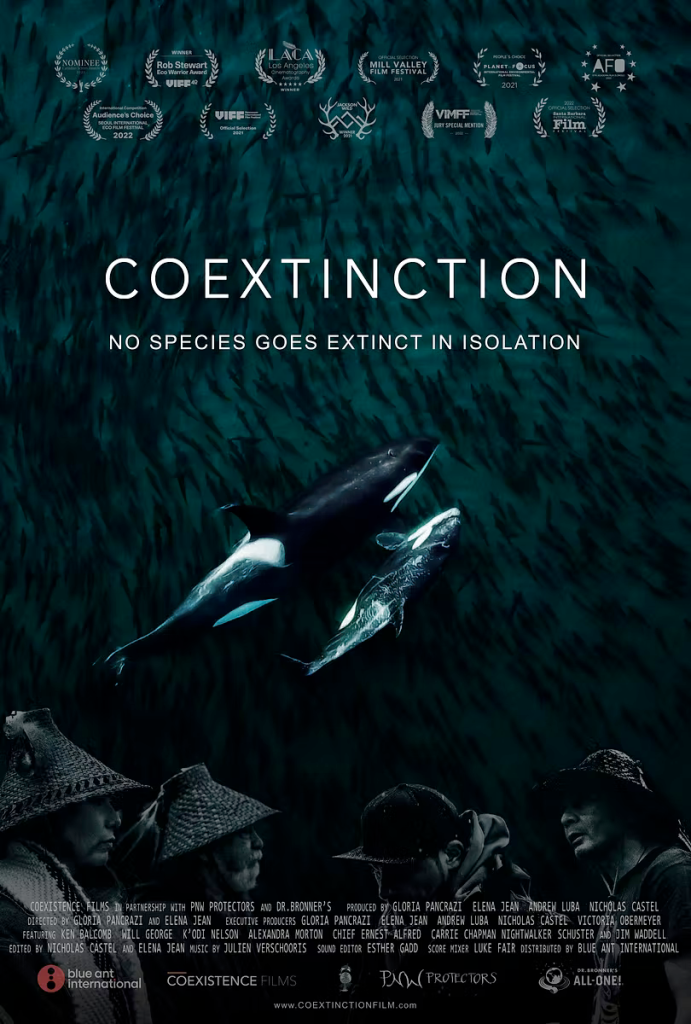
In 2021, two filmmakers, Gloria Pancrazi and Elena Jean, released a documentary called Coextinction. 🎬
They set out to film orcas. They ended up documenting the collapse of an entire ecosystem, from the depths of the ocean to the heart of the forests.
Without salmon, orcas starve
The documentary Coextinction opens with an image that became famous. In 2018, an orca named Tahlequah carried the body of her dead calf for 17 days, over more than 1,500 kilometres. 🐋
This grief was not an isolated tragedy. Just over 70 Southern Resident orcas remain in the Pacific Northwest, and their calves rarely survive because of a lack of food.
These orcas eat almost exclusively Chinook salmon, which account for around 80% of their diet. Yet Chinook salmon populations are collapsing because of dams, open-net fish farms, overfishing and shipping traffic.
Fewer salmon mean mother orcas struggling to feed their calves.
But the story does not end with the orcas. The same salmon also feed bears, eagles, wolves and even trees. 🌳
As they swim upstream to reproduce, salmon carry nitrogen from the ocean into the forests. Bears leave their carcasses beneath trees, where they fertilise the soil.
In British Columbia, studies have found that between 14% and 60% of the nitrogen in riverside plants comes from salmon.
“Trees do not grow by themselves,” forest ecologist Suzanne Simard reminds us. And when salmon decline, ecologist Yuri Zharikov explains, everything else also declines as a consequence.
This is where the documentary gets its title. Losing one species rarely means losing only one.
Co-extinction: a term that predates the documentary
The term “co-extinction” has existed since 1993, long before the documentary. Researchers Nigel Stork and Christopher Lyal used it to describe a situation in which one species disappears and another species, which depended entirely on it for survival, disappears in turn.
A study published in the journal Scientific Reports gave further weight to the concept. Its authors describe co-extinction as “a manifestation of the interconnectedness of organisms” and warn that it is difficult to detect because it progresses silently.
Since then, research has measured the scale of the phenomenon.
By simulating thousands of “virtual Earths” populated by more than 30,000 species connected through food webs, researchers Giovanni Strona and Corey Bradshaw showed that these chain reactions are likely to be a major driver of biodiversity loss.
They could increase the extinction of the most vulnerable species by 184% by 2100. A species therefore rarely matters only for its own sake. It also matters because of everything it supports around it—including what eventually ends up on our plates.
Why biodiversity and food go hand in hand
The extinction of one species can cause others to disappear for two main reasons.
The first is that certain species play a much greater role than their numbers might suggest, maintaining the balance of an entire ecosystem. The second is that every species provides services on which other species—and often the whole environment—depend.
The sea otter holds an entire forest together
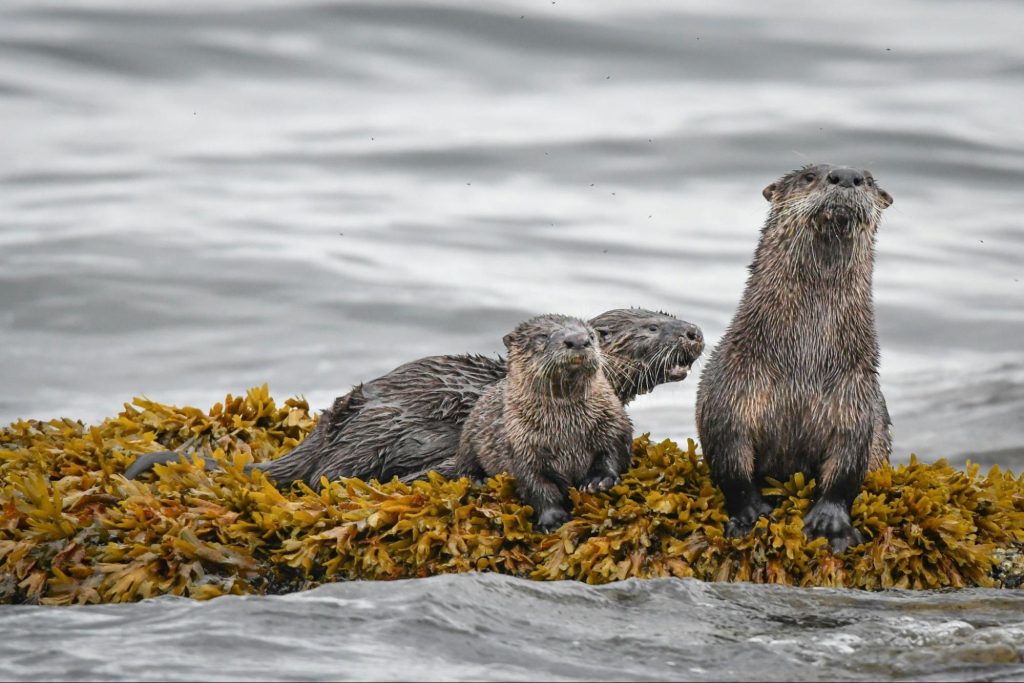
Along the northern Pacific coast lives a small sea otter that feeds on sea urchins. Sea urchins, in turn, graze on kelp, the large brown algae that form genuine underwater forests. 🦦
At the beginning of the 20th century, sea otters were hunted almost to extinction for their fur.
Without their predator, sea urchin populations multiplied and devoured the kelp forests, leaving behind barren areas that scientists call “urchin barrens”.
As the kelp disappeared, so did the fish, crabs and birds that relied on it for shelter. Biologists Jim Estes and John Palmisano demonstrated this as early as the 1970s by comparing coastlines with and without sea otters.
But it is not only species that disappear.
Kelp forests store enormous amounts of carbon, and researchers from the University of California have estimated that the presence of sea otters can increase these marine forests’ carbon-storage capacity twelvefold.
Protecting a sea otter therefore also means protecting the climate. Wherever sea otters have returned, the forests have grown back—and life has returned with them.
The services nature provides for free
Every species performs a kind of job within its ecosystem.
Some pollinate plants, while others disperse seeds, recycle dead matter or transport nutrients from one environment to another. These services cost us nothing, yet nothing works without them.
Pollination is the best-known example. According to IPBES, more than 75% of the world’s major food crops depend, at least partly, on animal pollinators, most often insects.
This is where the connection between biodiversity and food becomes clear: when these insects disappear, our fruit and vegetables are put at risk. 🐝
At this point, co-extinction stops feeling like a distant issue. Salmon fertilise forests, sea otters protect the climate, bees pollinate fruit trees, and bats control pests. All of this provides us with food, air and water.
Remove one of these links, and the service it provided disappears with it. When that link helps grow the food we enjoy eating, our food supply is affected too. 🍎
Cocoa: where biodiversity and food come together
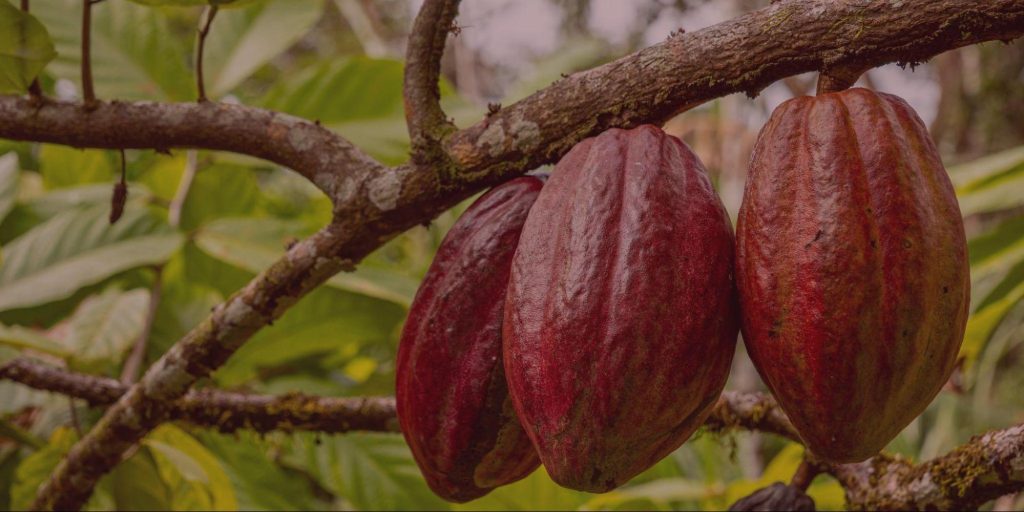
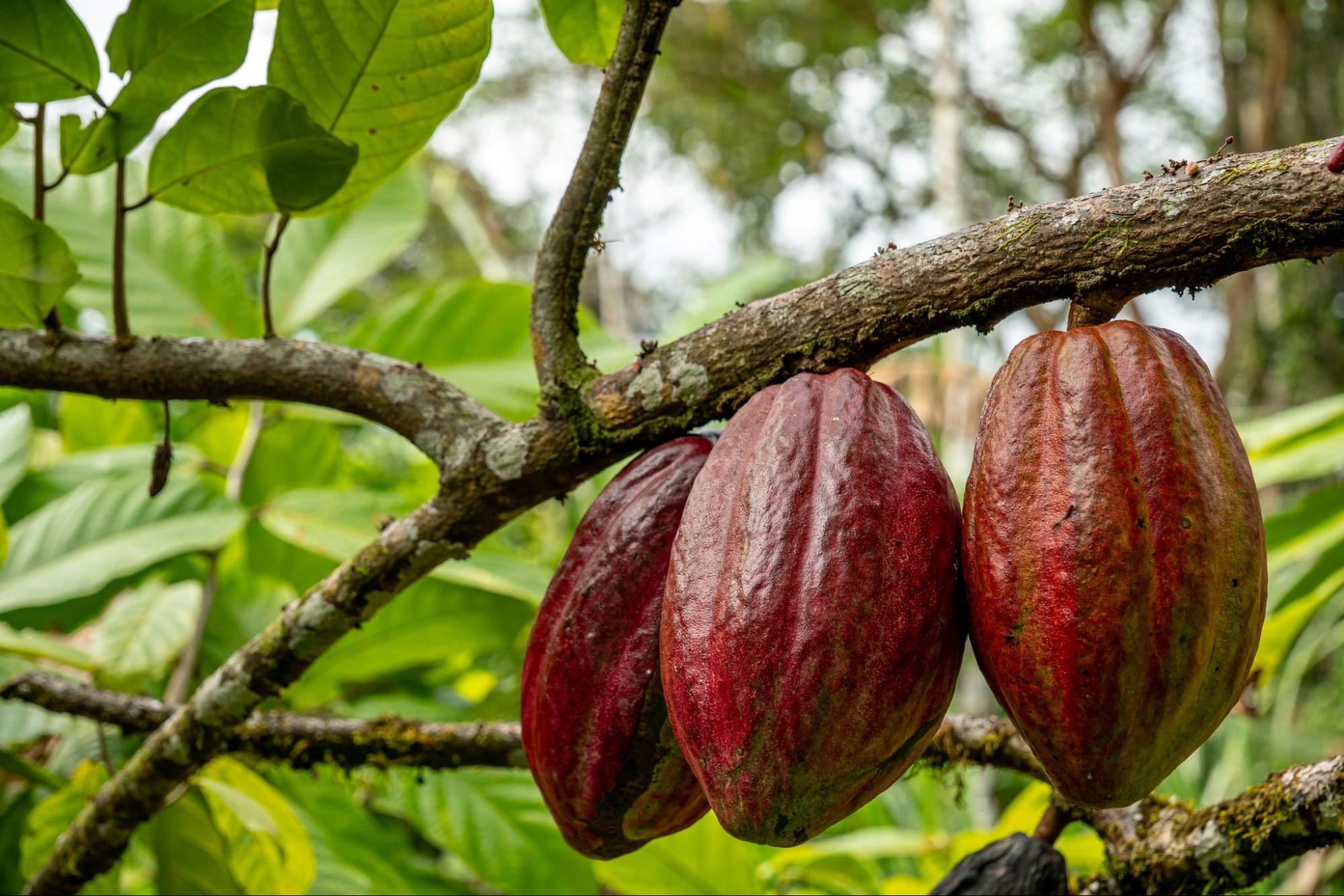
The cocoa tree also depends closely on these relationships. In the wild, it never grows alone. It is an understory tree that develops in the shade of taller trees.
Consider cocoa flowers. They are far too small for bees or butterflies. Instead, they are pollinated by tiny midges, less than one millimetre long, which can only live in the moisture of decomposing leaves beneath the shelter of a forest. 🦟
Without forests, there are no midges. Without midges, there are no cocoa pods—and therefore no chocolate. 🍫
Cocoa, too, hangs by an invisible thread.
Monoculture cuts this thread. The forest is cleared, cocoa trees are planted alone in full sunlight, and the species that once helped them thrive disappear. The trees then survive with the support of pesticides, used to replace what nature previously provided without asking for anything in return.
The same chain of disappearance threatening orcas is repeated here, inside a simple cocoa pod.
A cocoa tree supports far more life than we might imagine, and every species plays its part.
Cocoa is therefore a perfect example of the connection between biodiversity and food. The chocolate we eat ultimately depends on a forest that has remained alive. Preserving it is already an act of biodiversity protection.
How agriculture breaks the link between biodiversity and food
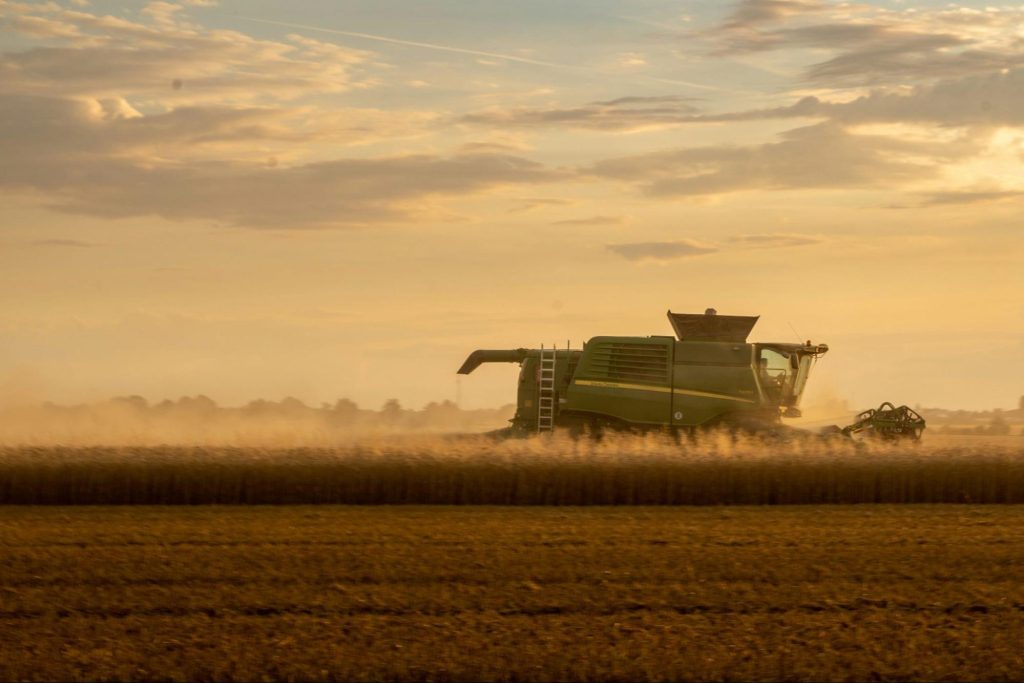
All of this may seem far removed from our daily lives because we never see the forests being cleared to fill our plates. They disappear thousands of kilometres away, beyond our view.
Yet the link between biodiversity and food is direct.
According to IPBES, the leading cause of habitat destruction worldwide is agricultural expansion, which eats into forests to make space for crops and livestock.
Together, agriculture, fishing and climate change are currently pushing nearly one million species towards extinction.
We partially finance this agricultural model ourselves, one shopping basket at a time. A product grown through intensive monoculture supports a system that turns entire forests into fields containing only one plant, where almost nothing else can survive.
An organic product or one grown through agroforestry supports a model that leaves room for other species.
Elena Jean, co-director of Coextinction, clearly summarises the trap we have fallen into: instead of consuming less of a resource that is running out, we constantly try to replace it with another.
This is how we empty the oceans of wild fish and then install open-net fish farms that contaminate the remaining wild salmon. 🐟
Even choices that seem insignificant, such as deciding which foods to buy, have an impact on nature. At our own level and within our own means, we can contribute to biodiversity protection by:
- Choosing organic or agroforestry-grown products,
- Reducing food waste,
- Eating less industrially produced meat,
- Avoiding plastic whenever possible,
- Choosing brands that are transparent about where their products come from,
- Supporting organisations that protect living systems.
Every choice pulls on a thread, in one direction or the other.
Our commitment to biodiversity protection
Saving one species at a time is not enough.
At CAOYA, through our organic chocolate, we aim to protect nature while preserving the interconnected relationship between biodiversity and food.
It begins with the cocoa we choose. We work with regions where the forest has remained alive and where cocoa trees grow through agroforestry, surrounded by the species that have always lived alongside them.
Cocoa that has not required anyone to clear a forest in order to exist.
It is also reflected in our commitments. We donate 10% of our profits to partner initiatives working to protect biodiversity.
This year, we are supporting pollinators alongside Un Toit Pour Les Abeilles, because these insects make much of the food we eat possible, even though they do not pollinate cocoa. 🐝
We hope to go even further in the future by helping protect bird habitats, as the presence of birds can tell us a great deal about the health of an environment.
For us, protecting one link already helps strengthen the entire chain. It is our way of showing that a square of chocolate can help care for something much bigger than itself. 🍫
Caring for the connection between biodiversity and food
Species extinction never happens in isolation. This is the story told by the documentary Coextinction. Every disappearance silently prepares the way for others.
But the same principle also works in the opposite direction. Because everything is connected, protecting one species or one habitat means protecting many others at the same time.
This is the very principle of biodiversity protection.
WWF France’s latest biodiversity report has a title that captures the situation well: “Between decline and hope.” Hope is real wherever space is given back to living systems. Sea otters return, and forests grow back.
And because biodiversity and food hang by the same thread, what we put on our plates matters too.
Every one of our actions pulls on a thread. Together, we may as well pull in the right direction.
Questions Fréquentes
What is the connection between biodiversity and food?
Everything we eat comes from a living environment: a pollinator for fruit, a forest for cocoa. The way we produce and choose our food largely determines what can continue to survive around these crops.
When food is grown organically or through agroforestry, it leaves room for living systems. Intensive monoculture causes them to retreat.
Can the disappearance of a single species really disrupt an entire ecosystem?
Yes, because species are connected through what they eat and through the services they provide.
A predator controls the population of its prey, a pollinator enables plants to reproduce, a fish transports nutrients, and a tree provides shelter. When one of these species disappears, the balance is disrupted.
When sea otters disappeared, sea urchins were able to destroy entire kelp forests, and all the life that depended on those forests collapsed with them.
Can biodiversity protection begin with a single species?
Yes. Because species depend on one another, protecting one link often benefits the whole network.
By protecting sea otters, we also protect kelp forests, the fish that shelter within them and the carbon those forests store.
This is precisely why protecting key species or their habitats is so important.
Can species extinction still be reversed?
To some extent, yes. Wherever habitats are protected or restored, nature often returns more quickly than we might expect. The return of sea otters to parts of the Pacific coast was enough to allow entire kelp forests to grow back.
However, researchers Strona and Bradshaw warn that the coming decades will be decisive. The longer we wait, the more difficult these chain reactions will be to stop.
How is chocolate connected to biodiversity?
Chocolate comes from cocoa. To produce cocoa beans, the cocoa tree depends on a living forest: tiny insects to pollinate its flowers, tall trees to provide shade, and ants and birds to protect it from pests.
When cocoa is grown through agroforestry, it helps preserve this biodiversity. When it is grown through monoculture, it destroys it.
The chocolate we choose supports one of these two models.