 our story

Eating is such an everyday act that we forget its weight.
Today, our food choices account for around 25% of carbon emissions in France. A quarter. Simply through what we put on our forks.
Sustainable eating starts from the idea that what we put on our plate, three times a day, every day, can play a role for ecosystems and biodiversity
Becoming aware of this is giving ourselves a reason to act, with curiosity and intention. Because if our food choices can degrade ecosystems, they can also protect them.
That is where the difference lies.
What our current food system does to the planet
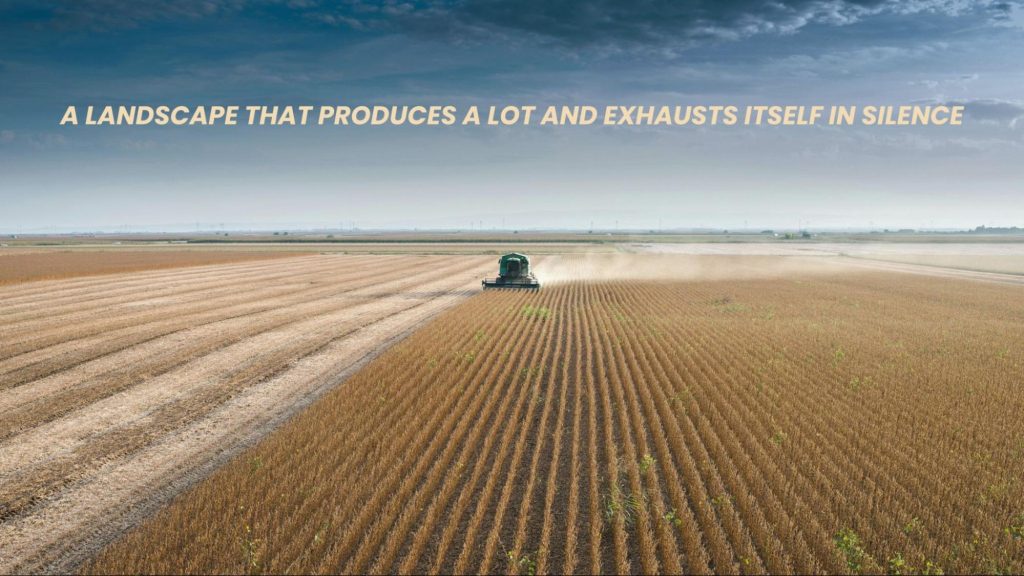
The global food system as it functions today was built to produce fast, in large quantities and at low cost. It has achieved that. But at a price that nature feels deeply.
The carbon footprint of our plate
Food and climate change are linked in ways we have been measuring more clearly in recent years. 22% of our food choices directly influence the overall carbon footprint of the French.
According to WWF France, if the French adopted sustainable consumption principles, greenhouse gas emissions across the entire food chain could fall by 40%.
What is striking is where these emissions come from. One might assume they come from transport or packaging. In reality, 61% of greenhouse gases linked to our food come from agricultural production itself.
In other words: what happens in the field weighs far more heavily than the distance the product has travelled. Meat and dairy products alone account for 85% of emissions from French agricultural production, according to ADEME.
Intensive farming and its damage to nature
The carbon footprint is visible. What is less visible is what industrial agriculture does to the living world, more silently.
Between 1990 and 2020, 420 million hectares of forest disappeared worldwide, an area the size of the European Union, primarily for livestock and crops.
The core problem is that by clearing these forests, they can no longer store the carbon, which is the main driver of climate change. Worse still, the farmland that replaces them actually emits it.
On the ground, monocultures and synthetic pesticides (non-natural) decimate the micro-organisms that keep soil healthy. The pollinating insects that depend on these organisms disappear along with them.
Yet pollinators are essential to our crops. In France, 72% of species cultivated for our food depend on animal pollination, primarily insects. Without bees, for example, we lose our ability to feed ourselves.
And they are not the only ones affected. The 2024 WWF report documents a 73% decline in wild vertebrate populations since 1970. In just fifty years. This is due in part to intensive farming as we know it.
By uprooting hedgerows, ploughing up meadows and draining wetlands, every hectare turned into monoculture is one less habitat.
What sustainable eating offers
Faced with this reality, sustainable eating proposes choosing our food differently, by supporting farming models that rebuild rather than deplete.
Organic, agroforestry, regenerative: what changes
Organic farming bans synthetic pesticides and chemical fertilisers. Soils stay more alive, water less contaminated, insects better protected alongside all other animals. It is a first level of protection, with our organic certification, that matters deeply to us at Caoya.
Agroforestry goes further. It combines fruit or forest trees with agricultural crops, recreating diversity where monoculture had made everything uniform.
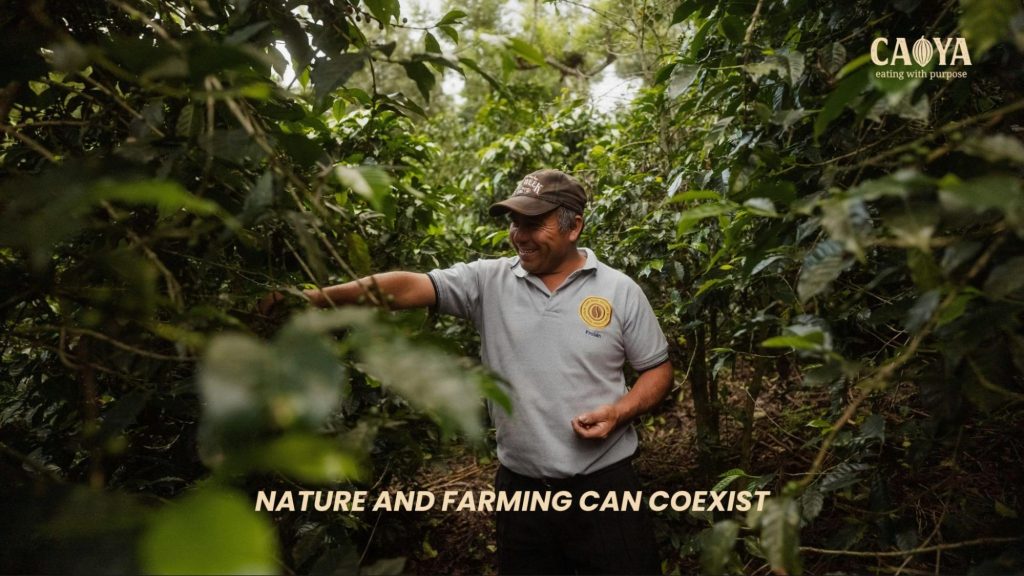
Our cacao grown through agroforestry is an example: it grows in the shade of other species, soils feed on the organic matter that settles there, birds and insects return. The land comes back to life.
Regenerative agriculture follows this path, seeking to repair what has already been damaged. Restoring soil fertility, recreating healthy water cycles, bringing biodiversity back to degraded land: the goal is no longer simply to limit impact, but to give back to the earth more than we have taken.
These models farm differently. They produce food while caring for everything around them.
The measurable impact of these farming practices
These practices have a real positive impact on nature.
Organic farms host on average 34% more species than conventional farms, according to the Journal of Applied Ecology.
Thanks to the microbes found in organic soils, there is more water retention, less erosion and superior nutritional quality in what we eat.
Agroforestry, for its part, stores more carbon than monocultures because it accommodates more trees, which also helps withstand extreme weather events (which are accelerating with climate change).
Products grown through agroforestry, like cacao, also have more flavour thanks to the richness of the soil in which they grew.
By choosing what you put on your plate, you contribute directly to the health of nature. And of course to your own health too.
Sustainable eating: where to begin?
The difficulty with sustainable eating is knowing where to start without getting lost in an endless list of restrictions to follow.
Reading labels without getting lost
Certifications exist to guide the way:
🌳 The Organic Agriculture label (AB) guarantees the absence of synthetic pesticides, chemical fertilisers and GMOs. It protects the health of soils, water and ecosystems, and is checked every year by approved independent bodies.
🌳 The Demeter label moves towards biodynamic farming (an approach that considers the farm as a living ecosystem, in harmony with natural cycles).
🌳 The ROC label (Regenerative Organic Certified) goes even further, integrating three pillars: soil health, animal welfare and social equity. It is the most ambitious certification on the regenerative front.
🌳 Fair trade logos guarantee fair pay for producers. At Caoya, we have chosen not to carry them. Their annual cost is high, and we prefer to directly value the quality of cacao in the remuneration of the producers who grow it.
No label is perfect. But they point towards supply chains that offer a better way to consume. Reading them is already a way of asking questions and staying curious when doing your shopping.
Beyond labels, traceability is a strong signal. Knowing where what we eat comes from, under what conditions it was produced and by whom: this information is more accessible than before, and brands that play full transparency deserve our attention.
Choosing an ethical chocolate
Cacao is one of the products whose environmental impact varies most depending on how it is grown.
In a conventional model, the cocoa farm is a monoculture that weakens soils, the species that depend on them, and requires large areas of land.
Grown through agroforestry, that same cocoa tree becomes something else entirely. One tree among others, in a landscape that breathes. Soils are no longer artificially irrigated. Vegetation protects against erosion. Pollinators return, and so do birds. And farmers, by diversifying their crops, are less exposed to price crises.
A square of chocolate can be a symbol of sustainable eating, one that protects nature. And that is exactly what we seek to do at Caoya: turn an everyday pleasure into an act that means something.
Protecting nature starts with sustainable eating
Sustainable eating is not one more constraint in an already busy life. It is a different way of looking at what we eat, with a little more curiosity for what happens before it reaches our plate, around us.
The food choices we make every day fund a certain type of farming, a certain relationship with the land, a certain future for the species that share this planet with us.
Nobody eats perfectly. But everyone can start somewhere.
At Caoya, we believe that pleasure and awareness can coexist in the same chocolate bar. If you want to go further on this journey with us, join the Caoya community.
FAQ : Sustainable eating
Is eating local truly eco-friendly?
Not necessarily.
A locally grown product from intensive monoculture can have a less favourable environmental impact than an imported product from organic agroforestry. The type of farming matters in fact more than the distance travelled.
Is plant-based eating always more sustainable than animal-based eating?
Overall yes, but with important nuances.
Extensive outdoor grass-fed farming contributes to meadow biodiversity and stores carbon. Environmental impact depends above all on the production method.
Reducing red meat and dairy from intensive farming remains the most powerful lever (beef accounts for 83% of emissions from French livestock farming according to ADEME).
For those who love meat, the idea is not to give it up entirely. Varying your diet and finding a balance is enough to make a real difference. Not eating red meat just one day a week, for instance, is as beneficial for the planet as eating strictly local at every meal.
How to recognise a genuinely eco-friendly product without being misled by greenwashing?
Three reliable signals: a recognised certification (AB, Demeter, Nature et Progrès, fair trade), clear traceability on origin and farming practices, and a brand that communicates its commitments with concrete data rather than vague formulas.
Greenwashing is often recognisable by the absence of verifiable facts.